White Stork
White Stork
Lebanon is considered the second-largest migratory bird route globally, according to the World Bird Council, and serves as a resting habitat for these birds. Many migratory routes cross Lebanese airspace along the south-north and east-west lines, reaching as far as Africa to the south and the Indian subcontinent to the east. Most birds pass through Lebanon during their dual migrations in spring and autumn. Many rest at Lebanese stations if safety is ensured, as the natural environment provides the necessary conditions, except for human interference by poachers.
These migrations play a crucial role in maintaining ecological balance in the areas where the birds stop, contributing to the sustainability of Lebanon's environment and helping farmers protect their crops from numerous pests. Several resting sites have been documented in Lebanon and the south, including Hma Abal Saqi and the Tyre Coast Nature Reserve ponds.
Leading these migratory birds is the White Stork, a large and strong bird measuring 100-125 cm in length, with a wingspan of 155-200 cm and a weight of 2.3-4.5 kg. Its feathers are entirely white except for the black tips of the wings, and its legs and beak are red.
White Storks face several threats, including drainage of wetlands, intensive agriculture, collisions with power lines, and pesticide use such as DDT. Their worst enemies, however, are poachers who kill them for amusement despite hunting bans. The White Stork is registered under the European, African, and Asian Migratory Waterbirds Agreements.
White Storks rely on warm air currents to fly long distances and also use the Sahara Desert as a route, avoiding flight over the cold Mediterranean. They take two main routes: east through Syria and Lebanon via the Bosporus and the Arabian Peninsula toward the Sahara following the Nile River, or west through Gibraltar.
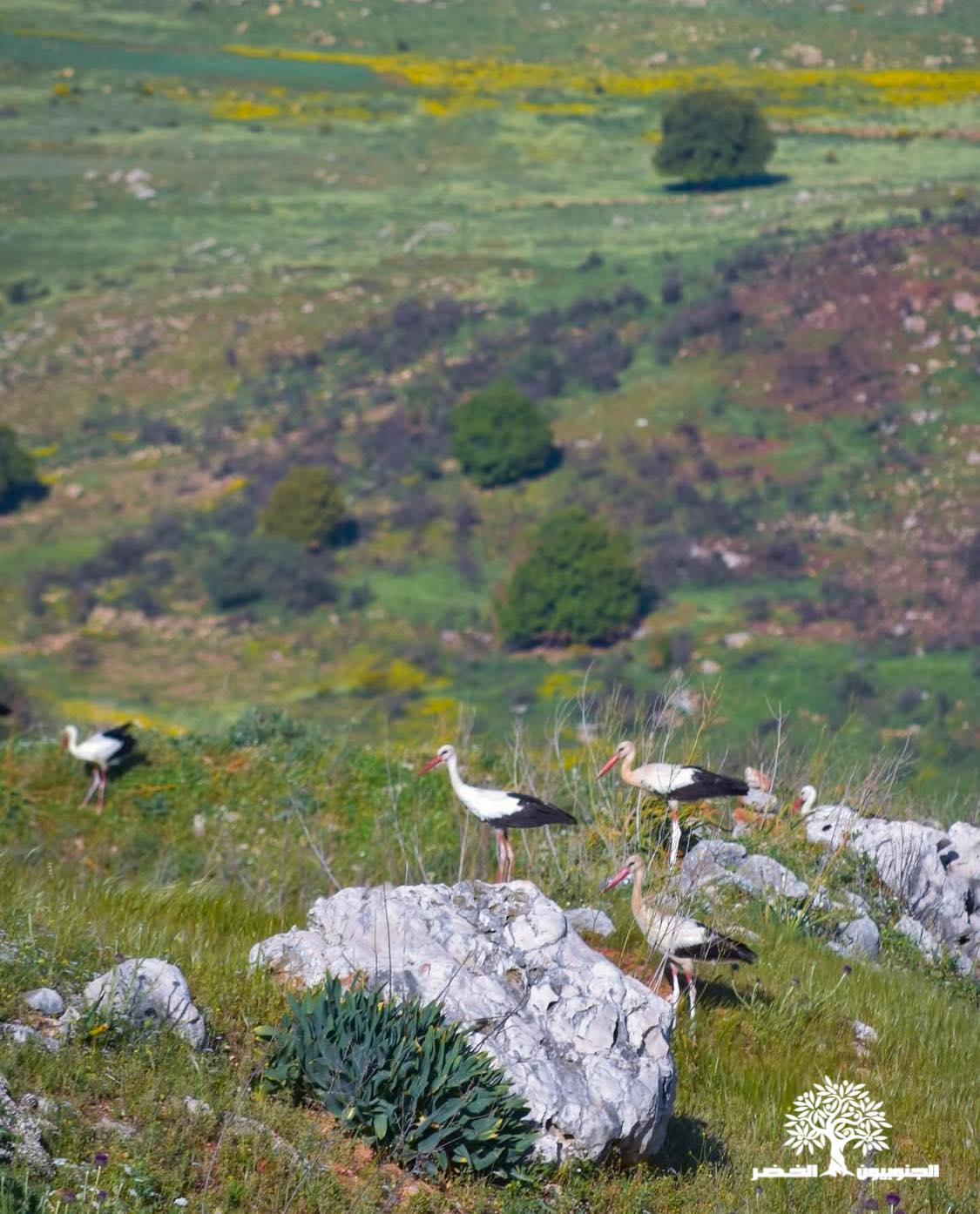
They breed in open agricultural areas, as well as wetlands and marshes, building nests on trees, buildings, and rooftops. Their diet includes fish, frogs, insects, small reptiles, rodents, and small birds. White Storks are generally silent and vocalize only at their nests.
In summer, White Storks fly south from Europe in August and September to spend winter in Africa, forming large flocks that may exceed a thousand birds. They return north to Europe in late March or April, after an average journey of 49 days, while the autumn migration takes about 26 days.
Related Posts
-
 Reptiles & amphibians
 -
 Hyenas (Hyaenidae)
Striped Hyena (Hyaena hyaena)
Lebanon’s national animal. Rare, nocturnal.
-
_4-large.webp) Invertebrates
Invertebrates