Ecocide
Green Southerners
Definition
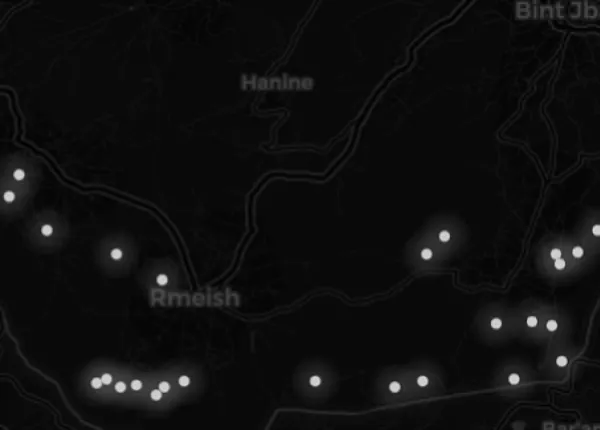
Since October 9, 2023, the team of the Green Southerners Association has been documenting grave environmental violations resulting from Israeli aggressions, which have caused extensive destruction of natural habitats, forests, woodlands, and agricultural lands across South Lebanon and the Beqaa Valley. These aggressions – through the use of white phosphorus munitions and other types of weaponry employing various destructive means – have led to widespread contamination of water, soil, and air, posing a direct threat to human health and wildlife. This section aims to present field data, maps, photos, and reports that reveal the magnitude of environmental and agricultural devastation and its far-reaching impacts on both the environment and society.
White Phosphorus
What Is White Phosphorus: Definition and Chemical Behaviour
White phosphorus (P₄) is a waxy, highly reactive solid that ignites spontaneously upon contact with oxygen in the air, producing phosphorus oxides that turn into phosphoric acids in the presence of moisture. According to the World Health Organization (WHO), white phosphorus adheres to the skin and can cause deep chemical and thermal burns that may reignite when residual particles in the tissues are re-exposed to oxygen.
Mechanisms of Harm to Health (Toxicology and Forensic Aspects)
- Deep combined thermal/chemical burns
White phosphorus causes deep thermal/chemical burns that adhere to tissues and may reignite when residual particles are exposed to air. Its fumes irritate the eyes and respiratory tract due to the formation of phosphoric acids in moisture. Systemic effects may appear with delay (up to 24 hours) and include hepatic and renal dysfunction as well as cardiac disturbances, which can be fatal in cases of severe exposure. Emergency records document recurrent ignition events and historical occupational toxicity such as jaw necrosis in chronically exposed workers.
Environmental Impacts and Field Evidence
Military use leaves behind residues of unburned white phosphorus and combustion products that can contaminate soil, surface water, and groundwater. The Eagle River Flats site in Alaska is documented as a contaminated Superfund area where U.S. Army research identified white phosphorus as a major cause of waterfowl mortality and imposed long-term remediation plans.
“Documented at Eagle River Flats (Alaska) with high waterfowl mortality and long-term response and remediation measures implemented” (EPA/USGS/Alaska DEC).
Military Uses
White phosphorus munitions are marketed militarily as tools for producing smoke screens, illumination, or marking/identification purposes, and in some cases are used as components that generate intense burning. However, this apparent distinction between “smoke use” and “incendiary weapon” is largely formal and does not change the practical reality: whether the declared purpose is concealment, illumination, or burning, the consequences of use are similar – severe and recurrent burns, persistent contamination of soil and water, and long-term harm to public health and wildlife.
Relying on the criterion of “primary purpose” in weapon classification creates a legal margin that seemingly justifies uses with incendiary effects and opens an ethical and legal loophole that facilitates impunity. In other words, it is not sufficient to define a weapon as being “for smoke” if its real effects are to burn people and the environment. Here lies the legal and moral responsibility of those who use and support it, and the need to pursue every use that exposes civilians and natural habitats to danger.
International Legal Status of White Phosphorus
Despite widespread international condemnation of white phosphorus for the devastating harm it causes to humans and the environment, this weapon is still legally classified as an incendiary weapon rather than a banned chemical weapon. This classification is based on the technical purpose of the weapon (starting fires or producing smoke) rather than its actual effects, which creates a clear gap in the structure of international humanitarian law.
Under the Chemical Weapons Convention (CWC), white phosphorus is not listed among the scheduled prohibited chemicals, because the ban focuses on toxic substances when their toxicity is used as the means of warfare, whereas white phosphorus operates through its thermal and incendiary effects.
By contrast, Protocol III to the Convention on Certain Conventional Weapons (CCW) prohibits the use of incendiary weapons against civilians or civilian objects and restricts their use in populated areas. Customary international humanitarian law rules 84–85 also require parties to take particular care to avoid civilian losses and to choose means and methods of warfare that cause the least harm, which provides a basis for qualifying the use of white phosphorus in urban areas as a violation of the principles of distinction and proportionality.
The legal focus on “design intent” rather than the real-world effects of the weapon leaves an ethical and legal gap that weakens the protection afforded to civilians and the environment.
CCW – Protocol III on Incendiary Weapons
Protocol III of the CCW sets out an absolute prohibition on directing incendiary weapons against civilians and civilian objects, and bans the use of air-delivered incendiary weapons in concentrations of civilians, while also restricting ground-based delivery systems.
However, the Protocol defines an incendiary weapon as a weapon “primarily designed to set fire to objects or to cause burn injury to persons through the action of flame, heat, or a combination thereof,” a definition centred on design intent rather than field effects. As a result, white phosphorus may sometimes be excluded from this definition under the pretext that its intended use is “smoke” or “illumination,” even though its real-world effects are incendiary and destructive.
This contradiction between formal classification and practical outcome represents a serious legal loophole that enables impunity and undermines the humanitarian purpose of the Protocol.
ICRC IHL Database – Protocol III (CCW)
Customary International Humanitarian Law (Rules 84–85)
Customary international humanitarian law obliges all parties to a conflict, whether or not they are party to the treaties, to exercise particular care to avoid or minimise civilian casualties when using incendiary weapons (Rule 84) and to choose means and methods of warfare that cause the least possible harm when alternatives are available (Rule 85).
In practice, however, these rules are regularly violated through the use of white phosphorus in populated or agricultural areas, turning this tool from a “smoke means” into an indiscriminate weapon that causes environmental and health devastation that cannot be justified under the principles of proportionality and distinction.
ICRC Customary IHL Database – Rules 84–85
Chemical Weapons Convention (CWC) and the OPCW
The CWC does not list white phosphorus among the prohibited chemicals because it is not used primarily for its chemical toxicity but for its thermal and incendiary effects. Accordingly, white phosphorus is not considered a chemical weapon under the technical definitions of the Convention and remains classed as a conventional incendiary weapon.
This separation between the “chemical” and the “incendiary” dimensions creates an ethical and legal gap: when a weapon causes toxic and long-lasting environmental effects comparable to those produced by chemical weapons, its legal classification loses much of its relevance in reality.
OPCW Technical Secretariat – Chemical Weapons Convention, Annex on Chemicals
Heavy Metals
Pollution by heavy metals is one of the most silent and persistent forms of environmental destruction. Unlike explosive or phosphorus weapons, which leave an immediate and visible trace, heavy metals infiltrate soil, water, plants, and human bodies along a slow but lethal path, generating long-term contamination that alters the structure of the environment and extends its effects over generations.
In the context of armed conflicts, particularly in South Lebanon and the Beqaa, explosive munitions, shells, and military residues leave high levels of lead (Pb), copper (Cu), cadmium (Cd), zinc (Zn), and depleted uranium (DU). These elements interact with soil and water, causing widespread biological disruption and turning agricultural areas into permanent toxic hotspots.
Scientific and Environmental Dimension of Heavy Metal Pollution
Heavy metals do not degrade in nature. Instead, they bioaccumulate along food chains and reach humans through groundwater, vegetables, and agricultural products. Laboratory studies conducted in Lebanon and the wider region have shown that post-conflict accumulations of lead and copper in soils exceed the safety limits adopted by the World Health Organization (WHO) and the European Union, leading to reduced soil fertility, crop toxicity, and die-off of microorganisms that are essential to ecosystem balance.
Uptake of these elements by plants triggers chains of genetic and carcinogenic disturbances in living organisms and affects children and pregnant women in particular, through impaired liver, nervous system, and reproductive functions. In other words, metal pollution caused by munitions does not kill through explosions but through slow accumulation. It is a form of deferred warfare against the environment and against people.
International Legal Characterisation – A Legislative Void and Systematic Environmental Risk
To date, there is no explicit provision in international humanitarian law that classifies heavy metal pollution resulting from armed conflicts as a prohibited or punishable weapon, even though its environmental and health impacts are comparable – if not superior – to those caused by chemical or phosphorus weapons.
Legal references are largely limited to Articles 35(3) and 55 of Additional Protocol I to the Geneva Conventions (1977), which prohibit methods of warfare that are expected to cause widespread, long-term, and severe damage to the natural environment. On this basis, any military action that results in metal contamination that destroys soil, water, and agricultural space over many years constitutes a serious violation of these provisions.
Source: Additional Protocol I to the Geneva Conventions (Arts. 35(3) & 55)
However, the absence of a legal classification of heavy metals as a weapon in their own right enables polluting states to evade direct responsibility. International law often treats pollutants not as “munitions” but as “side effects” or “environmental consequences,” a distinction that weakens accountability and marginalises victims.
This legal vacuum places post-conflict metal pollution in a grey area between “incidental environmental damage” and “systematic ecocide,” offering perpetrators room to escape obligations of remediation and compensation, even though the principle of responsibility for internationally wrongful acts can clearly be applied in this context.
Source: ILC Draft Articles on State Responsibility, 2001
Ethical and Human Rights Framework – From Neglect to Ecocide
When metal contamination is left untreated, it becomes a form of ongoing environmental violence in which soil is rendered sterile, water becomes toxic, people are made sick, and wildlife is pushed towards extinction.
The issue thus goes beyond the environmental sphere into the realm of the right to life and dignity as set out in international human rights law. A state that leaves heavy metal pollution unremedied, or fails to clean up contaminated areas, bears a dual responsibility:
- Environmental responsibility under the rules on protection of the environment in times of conflict;
- Human rights responsibility under the International Covenant on Economic, Social and Cultural Rights (Article 12 – the right to health).
Source: UN Human Rights Committee, General Comment No. 14 (2000)
In this sense, metal pollution is not merely a “side effect of war” but a continuation of war by other means – a war against living beings, water, fields, and people.
Heavy metal contamination represents a form of silent ecocide, combining irreversible damage with long time scales of impact, in the absence of a clear legal framework for accountability. International humanitarian law in its current form recognises environmental damage without explicitly criminalising it, leaving a legislative gap that polluting powers exploit.
Nevertheless, the principles of distinction and proportionality, together with the rules on environmental protection during armed conflict, provide a sufficient legal basis to consider such destruction a war crime against the environment when intent or gross negligence is established, or when the act results in permanent damage to ecosystems and vital resources.
Destruction of Natural Habitats, Forests, Woodlands, and Agricultural Lands
This section covers the widespread destruction that has affected forests, woodlands, and agricultural lands in southern Lebanon as a result of shelling, fires, and systematic land clearing, with a focus on vegetation loss, degradation of natural habitats, and damage to agricultural soils. It provides field-based documentation illustrating the geographical and ecological transformation of the landscape, revealing the profound and lasting impact of warfare on ecosystems and the sustainability of rural and agricultural life.
It includes: before/after photographs, environmental maps, and testimonies from farmers and local residents.
-
 Analytics
 -
 Analytics